

The Untold History: Women JAG’s Rise in the Air Force Judge Advocate General’s Corps

“If a lady is a lawyer and she’s the most capable person for a particular position, she ought to be assigned to it without any consideration of her sex in the profession we practice.”
- Major General Reginald C. Harmon
From its inception in 1949, the Air Force Judge Advocate General’s Corps (JAG Corps) has been integral to mission execution for the United States Air Force and since 2019 the United States Space Force, providing legal support on a wide variety of military justice, civil law, and operational law topics. The journey for women in the JAG Corps is a narrative of breakthroughs, struggles, and progress. Women have been making significant contributions in the JAG Corps, overcoming numerous barriers to emerge as leaders and creating a lasting impact.
We do not often reflect on the history of our JAG Corps, let alone the rise of women among our ranks. It has been 78 years since the creation of the Air Force JAG Corps and the beginning of women’s service in the military, there is no better time than now, Women's History Month, to reflect upon this history. As early as 1950, women shattered glass ceilings within the JAG Corps and paved the way for the next generation of women JAG Corps leaders.
History of Women in Air Force JAG Corps
At the outset of this project, I thought uncovering women’s history in the JAG Corps would be a simple task; however, I quickly discovered that would not be the case. Of the available archives, it was shocking to find the “firsts” were not easy to identify. While this summation is certainly not all encompassing, these women had a hand in creating the foundation of the JAG Corps in which we are all privileged to serve.
The Early Years – The First Women Air Force Judge Advocates
The early years of women in the JAG Corps were marked by low representation. While women were permitted to serve in the military upon the enactment of the Women in Armed Services Integration Action of 1948, the passage of the law did not result in a substantial number of women serving early on. A review of 1949 Air Force Register noted “The first integration of women into the regular Air Force occurred too late for inclusion of the names in this Register;”[1] however, the 1950 Air Force Register did include the names of women.[2] The 1950 Air Force Register designated JAGs with a “J” annotation. Two women are identified with the “J” designation: Major Virginia A. Hardy and Major Evelyn F. Rees. Both women also appear in the 1949 Congressional Record with an appointment date of 17 February 1949.[3]

Lt Col Hardy’s name is listed under “Retired Officers” in the July 1960 JAG Bulletin (predecessor of The Reporter). At the time of this publication, no further information is known on how Lt Col Hardy or Maj Rees commissioned or transferred into the Air Force JAG Corps or details of Lt Col Hardy’s 1960 retirement after having served approximately 11 years.
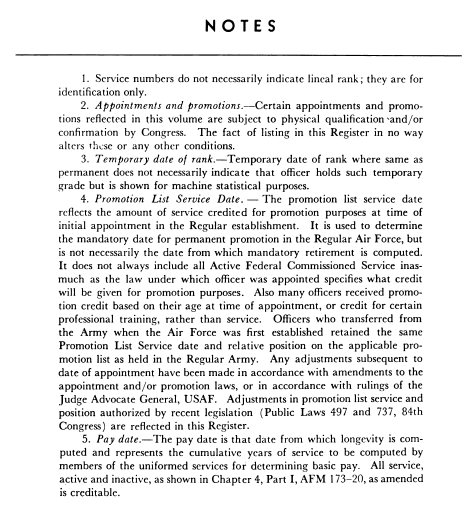
Note 4 of the 1958 Air Force Register potentially explains the missing information. It provides:
Promotion List Service Date. – The promotion list service date reflects the amount of service credited for promotion purposes at time of initial appointment in the Regular establishment. It is used to determine the mandatory date for permanent promotion in the Regular Air Force, but is not necessarily the date from which mandatory retirement is computed. It does not always include all Active Federal Commissioned Service inasmuch as the law under which officer was appointed specifies what credit will be given for promotion purposes. Also many officers received promotion credit based on their age at the time of appointment or credit for certain professional training, rather than service. … . [emphasis added][4]
The name of a third woman appears in the 1950 Register by the name of Dorothy E. Salipante.[5] While her name does not have a “J” designator next to it, an annotation of name changes in the 1952 Air Force Register indicated “Dorothy E. Salipante” changed her name to Dorothy S. Feddern on 13 July 1951.[6] The name Dorothy E. Salipante appears in the 1951 Air Force Register with the “J” designator.[7] It is unclear based on current research why the 1950 Air Force Register does not have the “J” designator. The Congressional Record indicates Dorothy E. Salipante was appointed to the grade of major in the United States Air Force on 28 July 1949.[8]

In 1950, the Judge Advocate General Staff Officer Course (JAGSOC) (the former name of the Judge Advocate Staff Officer Course (JASOC)) came to life under our first Judge Advocate General (TJAG), Major General Reginald C. Harmon. There were three JAGSOC classes in the inaugural year, the first graduating in 1951. A JAGSOC 51B (21 May to 10 August 1951) photo shows a woman by the name of Dorothy S. Feddern. The March 1960 JAG Bulletin lists “Dorothy S. Feddern” retired as a lieutenant colonel (date of rank confirmed in the 1958 Air Force Register as 1 August 1951). The Air Force Register lists Lt Col Feddern’s retirement date as 31 March 1959. Details of Lt Col Feddern’s 1959 retirement after having served approximately 10 years are unknown.
Based on this online research, it appears Lt Col Hardy and Maj Rees were indeed the “first” women JAGs to serve in the Judge Advocate General’s Department of the Air Force.
First Woman JAG to Rise to the Rank of Colonel

Another trailblazer in the early years was Colonel Jean E. Simpson (Morris). General Cheney recalled Col Simpson being assigned to his office at Third Air Force in 1960 when she was a captain. He described her as a “very capable lawyer.”[9] Then-Capt Morris published an article in the May 1960 JAG Bulletin titled Out-of-Court Hearing to Determine Legality of Search that is available in the JAG Corps archives. Col Simpson also worked for Major General Harold R. Vague, the 5th TJAG from October 1973 to October 1977, when they were both assigned to Fifteenth Air Force. He described her as “a very fine JAG” and “great on military justice.”[10]
Col Simpson graduated from Stanford Law School in January 1950, completing a three-year course of study in only two years and three months. She was admitted to the California bar in June 1950. She commissioned into the Regular Air Force JAG Corps in May 1951 as a first lieutenant at the age of 25. She received her orders to active duty on 20 August 1951 and reported to Travis Air Force Base, California, to begin her military career on 3 September 1951. She was assigned to the Women in the Air Force (WAF) squadron like every other woman at that time. Col Simpson began her career doing trial work. She recalled being only one of eight women out of 1200 members of the Air Force JAG Department. Interestingly, her name does not appear in any of the Air Force Registers from the 1950s.
In an oral history interview conducted on 6 and 7 November 2023 in Tallahassee, Florida, Col Simpson recalled much about her 21-year career. Surprisingly, she never attended any type of officer training like JAGs do today. She was shocked to learn that JAGs have formal training through Officer Training School. She did recall attending JAGSOC at Maxwell AFB, Alabama, in conjunction with her first duty assignment in Japan. She recalled in detail being given a task at that assignment to research Code of Federal Regulations provisions regarding the purchase and transport of foreign goods back to the United States. She said for that project she was required to provide her research and advice to the commander of the U.S. Far East Air Forces, who wanted to know if he and his spouse could bring back goods from Japan to their home in the United States. She recalled that, as a diminutive first lieutenant, she delivered advice that was not necessarily what the commanding general wanted to hear. Recognizing her work, her fellow JAGs gave her the nickname “Pee Wee the Fearless."
She provided she spent most of her career dealing in military justice and remembered and remembered working with the prosecution team on a manslaughter case in Japan during her first assignment. She also remembered a case involving a finance officer who, during his assignment in Japan, was directed to destroy U.S. dollars that were no longer needed. He faked the destruction of the money and kept it for his own benefit. She recalled he was sentenced to seven years at Leavenworth at general court-martial. Interestingly, it appears Col Simpson did not have any assignments at what we now call a “base level legal office.” Based on her recollection, it appears that she always served in general court-martial convening authority legal offices or higher headquarters. She was assigned to serve on the Joint Service Committee on Military Justice and was tasked to work on a Manual for Courts-Martial (MCM) rewrite. An experience that she really enjoyed.
She spent a lot of her off-duty time enrolled in developmental opportunities that she paid for out-of-pocket. These opportunities focused on operations and international law as she hoped she would be given an opportunity to work in that area. Unfortunately, when the opportunity finally arose late in her career, her personal circumstances had changed, and she decided to retire.
She detailed her travels around the world for each new assignment, including, Japan, California, and England, among others. Her travels were very different than what we experience now. She recalled having to ship her car from California to Ohio and then having to take a train herself to meet her car in Ohio to drive the remainder of the way to Massachusetts. She also recalled flying on “the General’s airplane” to Hawaii during her travel to Japan for her first assignment.
Col Simpson also recalled the federal litigation that changed the entitlements that service women received for their dependents. At the time, service women did not receive dependent pay entitlements like their male counterparts unless the woman could prove she provided 51 percent or more of her spouse’s support. Once this rule was struck down as unconstitutional, Col Simpson said she received “back pay” in the amount of roughly $1000.[11]
After 17 years of service in 1968, she became the first woman JAG to reach the rank of colonel. In a 1999 interview she recalled the following about her decision to apply to the Air Force JAG Corps:
The Manual for Courts Martial, 1951, was just about to take effect and the services had to have lawyers in their legal positions. In the past they’d been able to use people who were either non-lawyers in some trials or people who had law degrees, but who had elected to go on flying status. Certain trials from 1951 on were going to require certified trial and defense counsel and law officers, which meant that you had to be admitted to the bar of a state. So they had a need for lawyers. The Navy would take women, but the Navy at that time did not have a separate legal department at all—male and female lawyers were subject to being reassigned to non-legal duties by their local commanders. And the Army JAG did not accept women until several years later.[12]
Upon her retirement, she was awarded the Bronze Star Medal and the Legion of Merit in recognition of her 21 years of service.
First Woman Staff Judge Advocate, Chief Trial Judge & Air Force Criminal Court Appeals Judge

Inspired by the women’s liberation movement and the growing number of women attorneys in civilian society, more women began joining the JAG Corps as commissioned officers in the 1970s. They were instrumental in handling a variety of cases, demonstrating exceptional skill and proficiency in the courtroom; however, as evidenced by historical documents, women were still vastly underrepresented in the JAG Corps ranks.
While General Vague recalled there not being much of an influx of women into the JAG Corps during the women’s movement in the United States, but he did recall several women JAGs and one in particular he mentioned by name: Major Mildred “Millie” Raichle.[13] She entered the JAG Corps in 1966.
General Vague recalled when he became TJAG, Maj Raichle was up for reassignment. At the time, Maj Raichle was assigned to the special activities group in charge of the library. As he started reviewing her records, he realized he did not believe she had been properly assigned to that position. He opined, based on his review of her records, she had been relegated to non-legal jobs since she entered the Air Force, serving as an executive officer and another non-lawyer job prior to being put in charge of running the Air Force library. Ironically, General Vague also recalled Maj Raichle had left private civilian law practice because she was treated her like a legal secretary and not a lawyer just as the Air Force had been doing. General Vague recalled her being an intelligent woman with a good service and academic record. He realized the JAG Corps had never had a woman Staff Judge Advocate, and he thought she was the perfect candidate.
General Vague remembered calling Major Raichle to discuss the opportunity and described her as “reluctant” to take the opportunity, to his surprise. He remembered she expressed concern she would not be accepted as a Staff Judge Advocate. General Vague recalled telling her “You’ll be accepted gracefully, in my opinion.” He felt her hesitation was influenced by the fact the conversation occurred at the very beginning of women’s movement and because women in the JAG Corps had always been in subordinate roles.
General Vague did state he considered how the commander at the base might receive a woman Staff Judge Advocate “being shoved down his throat.” He told the sitting Staff Judge Advocate to ask the wing commander what he thought about the idea. The sitting Staff Judge Advocate reported back the wing commander had no issues with the proposition. So, Major Raichle became the first woman Staff Judge Advocate at Carswell Air Force Base, Texas. General Vague recalled, “She did a superb job, of course.”[14] Then-Maj Raichle eventually went on to become the second woman JAG to make colonel and the first woman JAG to be the Air Force’s Chief Trial Judge and an appellate judge twice on the Air Force Court of Criminal Appeals (22 December 1981 to 01 August 1985 and 07 September 1993 to 30 September 1995).
First Woman JAG General Officer

On 1 April 2003 Brigadier General Jarisse J. Sanborn became the first woman general officer in any of the Service’s JAG Corps. She was accepted into the Air Force’s Funded Legal Education Program in 1978 and began her JAG career following graduation from Creighton University School of Law. General Sanborn was also the first woman Staff Judge Advocate to the Commander, Air Mobility Command from March 2003 to August 2006. She was dual hatted as the Staff Judge Advocate to the Commander, U.S. Transportation Command as well, providing legal advice that enabled airlift operations at the start of the War on Terror. Prior to these appointments, she was the first Staff Judge Advocate to the Commander, U.S. Northern Command.
General Sanborn commissioned into the Air Force through Officer Training School as an executive officer in 1974. She recalled she did not consider a Reserve Officers’ Training Corps (ROTC) scholarship or going to the Air Force Academy because at that time women were not permitted to participate in those programs. She recalled when she first came into the Air Force the WAF squadrons still existed. She explained all women were assigned to a WAF squadron but performed their duties at other squadrons. In 1976, when women were accepted into the Air Force on an equal basis with men, the WAF program ended.
During her JAG Corps oral history interview, General Sanborn recalled being in the Air Force at that time as very “different” than it is now. While she was assigned to the WAF squadron, she performed her daily duties in a maintenance squadron. General Sanborn said she was lucky that there was another woman in the squadron and only recalled five to six women officers on the base excluding the nurses, which she said she never really saw. She described being a woman in a maintenance squadron at that time was “a real mixed bag.” She said the men really did not know how to treat women since they had not served with women. For example, she recalled a time a young Airman reported to the orderly room to ask for something. He initially called her “sir,” then “ma’am,” and then asked permission to ask her a question. He asked her whether he was supposed to call her “sir” or “ma’am.”[15]
Her 33-year career speaks to many current military women because her experiences as a single service woman, dual-military with her Air Force officer husband until his retirement and a married service woman with children demonstrates the opportunity to serve through all phases of womanhood and striking the balance between career and family. She reflected upon women’s service in the Air Force and called it “an evolution.” She opined as representation increases, she believes women’s experiences in the military are better and opportunities increase, leading to a better overall experience -- noting there is still work to do and continued progress is imperative. She noted she thinks as women look to balance career and family it becomes particularly difficult, often leading to separation from active duty, or immediate retirement as soon as eligible. She recalled herself having to evaluate her career especially when her son was born. When asked what advice she had for women JAGs, she said to take it assignment by assignment, recognizing the decision to serve is a very personal one. She recognized “it is tough” to serve but the opportunity exists for women to rise through the JAG Corps ranks.[16]
In an interview, General Sanborn recalled being the Staff Judge Advocate at Seymour Johnson Air Force Base, North Carolina, at the start of the Gulf War. The entire fighter wing was tasked with deploying, including herself as the Staff Judge Advocate. She remembered much debate around whether she should go on the deployment since she was a woman and might not be well received by her counterparts in the Saudi Arabian military. She said most of the hesitation came from within the JAG Corps. She recalled her chain of command all the way up to the Commander, Air Combat Command, being adamant she go despite the JAG Corps reservations. Ten days after the rest of the wing departed, she was finally cleared to join her unit in Saudi Arabia. During the deployment, she recalled there had never been a woman in the Saudi Arabia Ministry of Defense office. After her arrival, it took several days to get the Saudi Arabian Minister of Defense to designate one of the bathrooms in the large building for women’s use. She recalled they simply were not accustomed to women serving in the military. Despite this, she stated she worked well with her counterparts and left with memorable experiences and new friendships.[17]
In June 2019, the Secretary of Defense appointed her to the Defense Advisory Committee on Women in the Services, an organization chartered to provide advice and recommendations on matters related to the recruitment, retention, treatment, employment, integration, and well-being of women in the Armed Forces.
Women JAGs Breaking the Glass Ceiling
Since 1950 when the first women JAGs entered the JAG Corps, women’s representation in our ranks has certainly grown. General Harmon recalled there being more women in the JAG Corps than any other Service during his tenure as TJAG from 1948 to 1960. He recalled being questioned by the other Services on why he had so many women working in the Department. To which he recalled responding, “I find them very efficient. They do good jobs.” General Harmon did interestingly note even at that time dual military assignments were a challenge impacting women’s continued service. He recalled they were challenging especially if the other spouse was in a separate Service. He remembered one example where the Air Force worked with the Navy to keep a woman JAG, who General Harmon described as an “excellent” lawyer, with her Sailor husband.[18]
General Cheney recalled serving alongside women as early as the late 1940s. He provided there were not many women JAGs during his service but there were some. He recalled women JAGs such as Lt Col Janna Tucker, Maj Rose Volino, and Martha Sue Stokes as having been some of the earliest women JAGs to serve. General Cheney also recalled Maj Rose Gardner serving in the 1950s.[19]
Major General Vague recalled only four women in the JAG Corps during his tenure as TJAG from October 1973 to October 1977. When asked “did you have problems assigning female officers with their husbands? Do you recall?”, General Vague recalled only one woman JAG was married. He remembered that Colonel Jean Simpson married later in her career only shortly before her retirement and that Col Raichle was not married. He stated at one time there was a woman JAG married to an Office of Special Investigations (OSI) officer but that was the only dual-military couple he recalled. He stated there were no assignment restrictions for women JAGs, and their assignments were chosen just like any other officer. General Vague also commented that women JAGs were just as effective as their male counterparts in every job they were assigned to.[20]
Major General Robert Gruber, the Air National Guard Assistant to TJAG from September 1999 to June 2003, recalled there only being one woman JAG Air National Guard colonel when he assumed the position. At the end of his tenure that number had risen to six.[21]
In the last 78 years the JAG Corps has seen four women Regular Air Force JAG Corps officers promote to the general officer ranks. Women JAGs have also served as Staff Judges Advocates at all levels of command to include the major command, advising the Department of the Air Force’s most senior leaders. In July 2008, Col Dawn E.B. Scholz became the first woman Staff Judge Advocate to the Commander, Pacific Air Forces (PACAF). She served in that position until July 2010 when another woman JAG, Col Tonya Hagmaier, assumed the position. Prior to Col Hagmaier’s assignment as the PACAF Staff Judge Advocate, she became the first woman Commandant of the Air Force JAG School, serving from 2008 to 2010.
Another woman JAG served after Col Hagmaier as the PACAF Staff Judge Advocate from June 2012 to August 2016: then-Col Sharon Shaffer, who would later become the first woman Staff Judge Advocate to Commander, Air Combat Command (August 2016–May 2018) and then, on 8 May 2018 upon her appointment to brigadier general, the first woman Regular Air Force JAG to command the Air Force Legal Operations Agency (AFLOA) until her retirement in 2020.
In 2010, Col Lisa Turner became the first woman Staff Judge Advocate to the Commander, Air Education and Training Command, the oldest major command in the Air Force, where she served until 2013. Prior to that, she was also only the second woman Staff Judge Advocate to the Commander, Air Mobility Command from May 2013 to July 2014.

Another example of a woman JAG leading within the Corps is Lt Col Rose Volino. General Vague recalled her time as the head of the LITE (Legal Information Through Electronics) (predecessor to FLITE) office in Denver, Colorado. He opined “she had been probably mishandled during her career,” noting she had never been a staff judge advocate and only had held various subordinate staff positions. He recognized she did a good job leading the LITE office. He remembered her as a “self-made” woman that had financed her New York Law School education by singing and playing the piano. She is largely credited with brokering the deal between the JAG Corps and West Publishing Company “where the Air Force would give West magnetic tapes it was producing of all the old cases in exchange for tapes in the new cases as they were produced,” allowing LITE “to substantially update its database for no cost” and saving the Air Force roughly eight million dollars.[22]
Other notable “firsts” include Lt Col Kim Sheffield who was the first Regular Air Force JAG to argue before the U.S. Supreme Court in U.S. v. Scheffer. Colonel Pamela Stevenson was the first woman and first African American Director of the Legal Information Services directorate, providing innovative, modern, and secure legal-focused information technology solutions. This list is only a snapshot of the many “firsts” the JAG Corps has witnessed.
In the last two years we have witnessed two women rise in the JAG Corps ranks. On 11 May 2021, Brigadier General Gail E. Crawford became the Regular Air Force JAG Corp’s first Black/African American woman general officer when she assumed responsibility over the JAG Corps Operational and International Law Directorate. General Crawford’s career path is unique because she is also the first Regular Air Force JAG general officer to have first enlisted in the Air Force as a paralegal and then later commissioned as a JAG. On 19 May 2022. Major General Rebecca R. Vernon became the Air Force JAG Corps first woman Deputy Judge Advocate General. Prior to that, she was the first woman Staff Judge Advocate to Commander, Air Force Special Operations Command, where she served from July 2016–July 2019.
The firsts are not limited to the Regular Air Force JAG Corps. Major General Cassie A. Strom was the first woman Air National Guard Assistant to TJAG from 2012 to 2015. Major General Dixie A. Morrow was the first woman to serve as the Mobilization Assistant to TJAG, and the first woman Air Reserve Component JAG to command the Air Force Legal Operations Agency from November 2010 to October 2011 and then again from May 2014 to July 2016. This was even before General Shaffer took command as the first woman Regular Air Force JAG.
Regular Air Force JAGs have also aspired to the general officer ranks outside of the JAG Corps. Brigadier General Linell A. Letendre became the first JAG ever to serve as the Dean of Faculty at the United States Air Force Academy in October 2019, where she continues to serve in that capacity. Further, Major General Kerry L. Muehlenbeck, Arizona Air National Guard JAG, was selected as the Adjutant General of Arizona in April 2021.
Despite our increase in numbers, all the women JAGs interviewed as part of the research for this article mentioned bias and barriers they overcame along the way. In an interview, General Shaffer shared what it was like to be a woman JAG. She recalled it was pointed out in the courtroom that the panel could allegedly see up the skirts of two women defense counsels. As the judge and counsels worked through the issue during a Rules for Court-Martial (R.C.M.) 802 session, she recalled one of the trial counsels saying “well if you just wore pants like the men we would not have this problem.” She recalled being shocked that the counsel first overlooked the severity of such an allegation and further made it seem like the women’s fault for being a woman versus the fault of the inappropriate behavior by the trial counsels. Further, she pointed out that at the time it was not viewed as “appropriate” or “acceptable” for women to wear pants. The solution the trial team came up with was to erect a skirt around the counsel table so that no one could see under that table. Initially, the skirt was only going to be used by the counsel table where the two women sat but later it was realized that both tables should likely appear the same to avoid any appearance of treating the women counsels differently.[23]
A commonality highlighted by those interviewed was the pressure that women felt to work harder than their male counterparts to prove themselves and to be competitive for promotion. In her interview, Col Simpson highlighted that she had a male Air Force colleague question her competitiveness for promotion to major, all but telling her she would not make major because she was a woman.[24]
Despite the barriers, bias and challenges, women JAGs have prevailed. Rising through the ranks so that now it is not an uncommon occurrence to have not one, but multiple women JAGs in a legal office. As time passes, our numbers grow at every rank and women hold leadership positions even outside the JAG Corps, demonstrating their ability to lead from the front, showing those women that come after them that it is possible to be a woman and to serve your country.
Conclusion
We stand on the shoulders of pioneers. While we have certainly come a long way since the early 1950s, we are still on this journey. There are still many “firsts” to be attained. We must continue to move the needle forward by shaping our own culture of inclusivity and helping our clients to do the same as we have done for 75 years. Our military readiness and lethality depend upon it. So, let us take this opportunity to celebrate how far we have come as a Corps but also reflect upon the work that still needs to be done. As long as we are on this journey, legal professionals will continue to be called upon by decision makers to shape and navigate the legal landscape as they work towards full integration of women in the military as directed 78 years ago. We also shoulder the burden of ensuring our own JAG Corps is meeting the mark on what true integration looks like.
As we strive for that goal, let us remember those who came before us, the challenges they overcame, the unique opportunity we all have as legal professionals to influence and shape our culture and the continued progress that awaits us.
The views and opinions expressed in this article are those of the author and do not represent the official views or opinions of the Department of War, the components, United States Air Force, the New Jersey Air National Guard, or the federal government.
[1] Dept. of the Air Force, 1949 Air Force Register, Dept. of the Air Force (Jan. 1, 1949), https://books.google.com/books?id=To7fAAAAMAAJ&printsec=frontcover#v=onepage&q&f=false.
[2] Dept. of the Air Force, 1950 Air Force Register, Dept. of the Air Force (Jan. 1, 1950), https://books.google.com/books?id=y47fAAAAMAAJ&printsec=frontcover#v=onepage&q&f=false.
[3] 95 Cong. Rec. 1357 (1949)
[4] Dept. of the Air Force, 1958 Air Force Register, Dept. of the Air Force (Jan. 1, 1958), https://books.google.com/books?id=epbfAAAAMAAJ&printsec=frontcover#v=onepage&q&f=false.
[5] Supra, note 2.
[6] Dept. of the Air Force, 1952 Air Force Register, Dept. of the Air Force (Jan. 1, 1952), https://books.google.com/books?id=JJDfAAAAMAAJ&printsec=frontcover#v=onepage&q&f=false.
[7] Dept. of the Air Force, 1951 Air Force Register, Dept. of the Air Force (Jan. 1, 1951), https://books.google.com/books?id=9rvygwc3zKMC&printsec=frontcover#v=onepage&q&f=false.
[8] 95 Cong. Rec. 11453 (1949)
[9] Interview by Lt Col Eugene M. Solimine with Major General James S. Cheney, TJAG, U.S. Air Force, in Satellite Beach, Florida (Mar. 10-12, 1992).
[10] Interview by Gary D. Null & Lt Col Eugene M. Solimine with Major General Harold R. Vague, TJAG, U.S. Air Force, in Riverside, California (Mar. 28-30, 1994).
[11] Interview with Col Jean Simpson, in Tallahassee, Florida (Nov. 6-7, 2023).
[12] Interview by Lisa Craft with Col Jean Simpson, in Tallahassee, Florida (Feb. 1, 1999).
[13] Supra, note 10.
[14] Id.
[15] Interview with Brig General Jarisse J. Sanborn, Staff Judge Advocate, U.S. Air Force.
[16] Id.
[17] Telephone Interview with Brigadier General Jarisse J. Sanborn, U.S. Air Force (Jul. 24, 2023).
[18] Interview by Col David M. Lewis, Jr. & Lt Col Ronald J. Rakowsky with Major General Reginald C. Harmon, TJAG, U.S. Air Force, in Arlington, Virginia (Mar. 5 & 12, 1987).
[19] Supra, note 9.
[20] Supra, note 10.
[21] Interview by TSgt Daniel Hotter with Major General Robert Gruber, ANG Assistant to TJAG, U.S. Air Force, in Stewart Air National Guard Base, New York (Sept. 6, 2022), https://www.dvidshub.net/video/861733/interview-air-national-guard-jag-corps-history-with-retired-maj-gen-robert-gruber.
[22] Supra, note 10.
[23] Telephone Interview with Brigadier General Sharon Shaffer, U.S. Air Force (Jul. 27, 2023).
[24] Supra, note 11.



Comments